Identifying the right patients isn't a one-off exercise on a dashboard. It's a continuous, iterative process, and the difference between a programme that moves the needle and one that doesn't.
You've probably heard the statistic: 5% of patients account for 50% of hospital costs. That's true, but used on its own, it's misleading.
That figure is retrospective. It tells you who was high-cost last year, not who will be next year. Build a Proactive Care programme around the wrong 5%, and clinical time gets spent on patients who were never coming back through the door anyway. The real challenge is predicting who will be persistently high-risk, year on year. That's a different problem, and it needs a different approach.
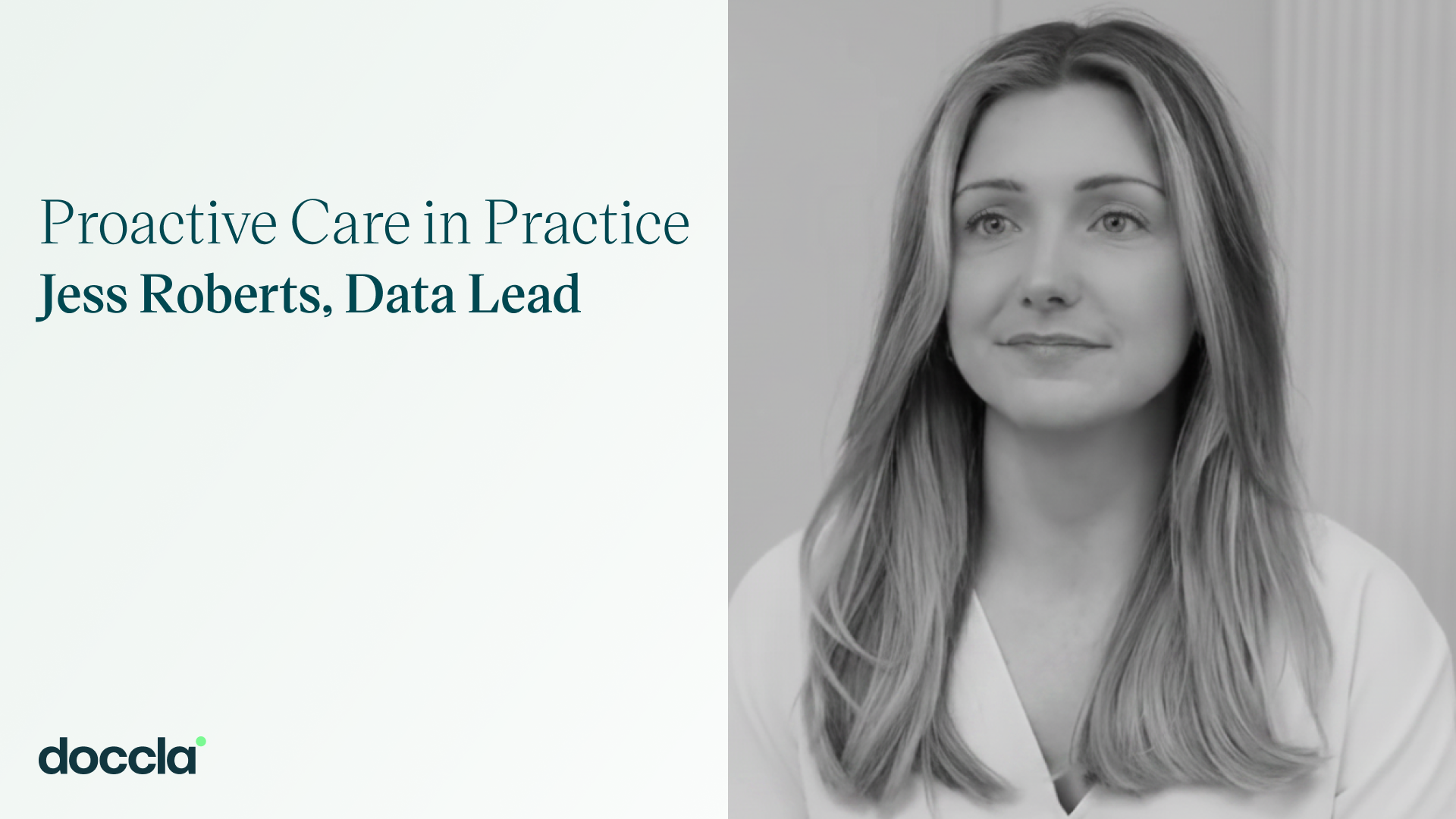
To understand what changes when programmes are built around prediction rather than retrospect, we asked Jess Roberts, Head of Data at Doccla, what data-driven Proactive Care actually looks like in delivery.
Identifying the right cohort
The biggest impactable area of hospital activity is emergency, non-elective admissions. Predicting who will have one in the next twelve months gets you much closer to a cohort Proactive Care can actually help.
There are several established models for this, with QAdmissions one of the most widely used in the NHS. Across all of them, the strongest predictive factors are consistent: a high-risk chronic condition such as heart failure or COPD, and a recent history of exacerbation, often a recent hospitalisation.
That gives a strong starting point, and from there Doccla layers in more predictive factors depending on the data available in each system. As Jess puts it: "The point isn't to build the most complex model. It's to focus the intervention where it can actually change the outcome." That means concentrating on patients who are persistently high-risk, not those who happened to have a one-off event last year.
Why single-condition models fall short
Heart failure and COPD have the most established evidence base for Proactive Care. Medicines titration for heart failure and pulmonary rehab for COPD both reduce hospitalisation risk.
But the data tells a more complicated story. Patients persistently at the apex of need rarely have just one condition. They're highly multimorbid and complex.
That's why Doccla's Proactive Care programme, delivered by its CQC-registered clinical team, layers holistic interventions on top of the pathway-specific ones: health coaching, care navigation, and 24/7 monitoring and support. As Jess puts it: "We treat the patient as a whole, not just the condition."
Doccla's standard inclusion criteria covers more than 20 high-risk chronic conditions, and the wider scale matters. By addressing the common drivers of decline across multiple conditions, and improving access to care for people who struggle to navigate the system, the programme captures a much larger percentage of the at-risk population. That breaks the cycle of repeated admissions in a way a single-condition approach can't.
The data, and the legal basis for contact
The data needed for risk prediction sits across the NHS: hospital activity in acute trusts, clinical history in primary care, and linked de-identified datasets held by ICBs.
Doccla works across all three. The team brings learnings from other systems on what's worked, but doesn't impose a methodology. They start with whatever prediction logic already exists locally and adapt the inclusion criteria to regional preferences.
The harder problem, Jess says, is usually not the list itself. "It's moving from a theoretical list on a dashboard to an active list of patients you can actually contact."
This is where a lot of Proactive Care programmes stall. You can produce a beautifully modelled cohort, but if there's no legal basis for contact, that list never converts into care. The legal basis is typically established through a pre-existing relationship: a GP registration, or a recent hospital discharge.
Knowing this upfront, and designing the programme around the data-sharing agreements you actually have (or can realistically put in place), is what keeps the implementation phase from becoming a governance bottleneck. It also forces clarity on accountability. Who is the controller? Who is the processor? Who owns the patient relationship? Those questions are easier to answer at the planning stage than after the cohort has been produced.
What data-driven actually looks like in practice
A learning mindset means validating assumptions with data at every stage, not just at evaluation.
Take outreach and enrolment: patients have to see value in a programme in order to take part, so Doccla teams use a batched approach, testing different channels (email, SMS, letters, calls, in-person events), different content, and different timings.
Every week the team reviews what worked, using A/B testing principles, because what works in one ICB doesn't always work in another, and the testing has to be continuous rather than one-off. Small changes compound.
The results speak for themselves: on a recent programme, Doccla took a list of 3,500 at-risk patients and reached a 50% enrolment rate within three months. Compared to standard engagement rates in primary care, that's a significant result.
The feedback loop on enrolment is short, so the team finds out quickly what works. Clinical interventions have a longer feedback loop, but the same principle applies. Every stage of the programme is being optimised: the message that gets a patient to enrol, the cadence of monitoring that keeps them engaged, the threshold that triggers a clinical contact, the protocol that escalates to the GP.
When every stage is iterating, the programme keeps improving long after the contract goes live. That's the difference between buying a piece of technology and partnering on a service.
The future: from "high risk" to "what if?"
What Jess is most excited about is counterfactual modelling. Today's models tell you a patient is high risk. The next generation will tell you what happens if you intervene. "This patient is at high risk, but that risk drops by 50% if we deliver X intervention today."
Doccla sits in a unique position to build that body of evidence. As both a technology provider and a CQC-registered clinical care provider, the team sees the impact of its interventions in near real-time. With limited clinical resource across the NHS, that level of precision matters.
The future is about precision and focus. The right patient, the right intervention, the right time, before a hospitalisation happens, not after.
Why this matters now
This isn't a niche operational improvement. It sits squarely inside the three shifts the 10-Year Health Plan is built on: hospital to community, analogue to digital, sickness to prevention.
And it's the moment the system is in. Every ICB has just submitted its Neighbourhood Health plan to NHS England. The strategic intent is set. The delivery question is what comes next: which providers can move from a model on paper to a contactable cohort in a community, at scale, with the clinical and data infrastructure to back it up.
Proactive Care is what those three shifts look like when they happen together: care delivered in the community, supported by digital infrastructure, focused on preventing the deterioration that drives admissions in the first place. Done properly, it doesn't just reduce hospital pressure, it changes the unit economics of running a health system.
That's the prize: a different model of care, not just better remote monitoring.

.png)